



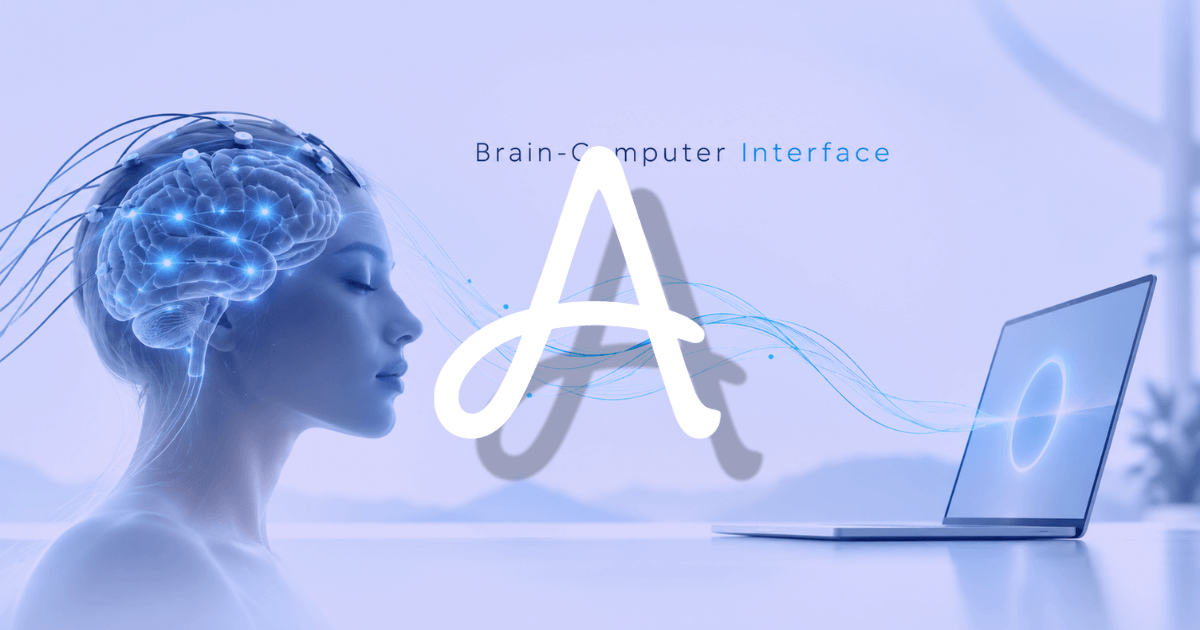
A brain computer interface (BCI) is a system that measures brain activity and converts it into an output, such as moving a cursor, selecting a letter or producing synthetic speech. It gives a person a way to interact with a device without relying on the usual muscle movement needed to type, click or speak.
The useful idea is straightforward: detect a pattern associated with an intended action, then translate it into something a computer can do. The difficult part is identifying that pattern reliably amid noisy, changing signals.
How does a brain computer interface work?
A typical BCI follows a repeating loop: signal collection, signal processing, command translation and feedback. Consider a simplified example in which a user learns to move an on-screen cursor.
1. Signal collection: measuring brain activity
Neurons communicate through electrical and chemical processes. Electrodes can record aspects of the resulting electrical activity, either from the scalp or from inside the skull.
With electroencephalography (EEG), sensors on the scalp detect voltage differences associated with the combined activity of many neurons. These recordings are not a list of individual thoughts. Implanted electrodes record closer to the source, with the detail depending on their location and design.
Electrical recording is not the only approach. Some research systems measure magnetic activity or changes in blood oxygenation associated with brain activity. EEG is a common choice for wearable, non-invasive systems.
2. Signal processing: finding a usable pattern
The recorded signal contains information the system needs and interference it does not. Eye blinks, muscle activity and electrical noise can contaminate EEG recordings.
Signal processing reduces unwanted components and extracts useful features, such as changes in the strength of particular brain rhythms. A decoder then estimates what the pattern represents. In our cursor example, it might distinguish patterns associated with imagining different movements.
Calibration helps establish that relationship for the user. Performance can change between sessions, so a system may need adjustment or further training.
3. Command translation: turning a prediction into an action
Command translation maps the decoder’s output to a device instruction. A detected pattern might become “move left,” select an on-screen option or contribute to a sequence of speech sounds.
For computer access, suitable software passes those commands to an application or the operating system that manages the computer’s hardware and software. The BCI supplies an alternative input route.
4. Feedback: showing the result
The user sees the cursor move or hears the generated speech. That feedback lets them judge the result and adapt their next attempt. A useful BCI needs this loop to be responsive and dependable, as well as accurate.
Non-invasive, semi-invasive and invasive BCI compared
These labels describe how sensors are placed. They do not, by themselves, tell you how well a particular device will work.
| Type | Typical sensor placement | Main trade-off |
|---|---|---|
| Non-invasive | Outside the skull, such as EEG electrodes on the scalp | Avoids implantation surgery, but scalp recordings have limited spatial detail and are sensitive to interference. |
| Semi-invasive | Inside the skull, on or near the brain’s surface, as with electrocorticography (ECoG) | Records closer to the brain without penetrating its tissue, but still requires surgery. |
| Invasive, penetrating | Electrodes inserted into brain tissue | Can capture highly local activity, but introduces surgical risks and challenges with long-term recording stability. |
“Semi-invasive” is not a universal classification. Surface electrodes are also described as invasive because they are surgically implanted. Checking the actual placement is more informative than relying on the label.
What can BCI technology do?
Assistive communication and control are major research uses. Depending on the system, a person may select letters, control a computer cursor or operate an external device such as a robotic arm. These are different tasks, each requiring an appropriate sensor setup, decoder and interface.
Speech is a particularly important example. In research published in 2025, a team at UC San Francisco and UC Berkeley used surface electrodes and a trained decoding system to turn one participant’s attempted speech into streamed synthetic speech. The participant had lost the ability to speak following a stroke. The result demonstrated a communication approach in that study, not a guaranteed outcome for every person.
Work also extends beyond laboratory sessions. A UC Davis study published in June 2026 examined home use of an implanted interface for speech and cursor control in a participant with ALS. It remained part of a clinical trial evaluating safety and feasibility.
BCIs are also studied for rehabilitation and experimental interaction with games or virtual environments. A demonstration of one task should not be taken as evidence that a device can perform every other BCI application.
Is a BCI the same as AI or mind reading?
No. The BCI is the complete connection between recorded brain activity and an output. Machine learning can help its decoder recognise patterns, but AI software alone does not measure brain activity.
Our guide to what generative AI does explains the separate idea of generating content. A BCI decoder’s job is to infer a task-related output from recorded signals; it should not be assumed to understand everything the user is thinking.
Some research has decoded imagined speech under specific experimental conditions. In a 2025 study published in Cell, researchers investigated inner speech using implanted electrodes and also tested methods to help protect private speech. Such results make consent and control important, but they do not establish unrestricted access to anyone’s thoughts.
What still limits BCI systems?
- Reliability: A successful demonstration does not establish dependable performance across users, tasks and everyday conditions.
- Setup and training: Sensor placement, calibration and user effort can affect practical usability.
- Implant safety: Surgery, infection risk, tissue responses and device durability need careful evaluation.
- Error handling: Users need practical ways to correct mistaken selections or speech output.
- Privacy and control: Important questions include who can access recordings, what is retained and how the user can stop decoding.
When evaluating a BCI claim, ask what task was tested, who used it, how much assistance was needed and whether it was a research system or a product authorised for that particular use. Speed alone is not enough to judge usefulness.
Frequently asked questions
Does every BCI require brain surgery?
No. Non-invasive systems such as scalp EEG use external sensors. Surface implants and electrodes inserted into brain tissue require surgical procedures, even when a surface system is called semi-invasive.
Does EEG recording send electricity into the brain?
EEG recording measures electrical activity; it does not require electrical stimulation of the brain. Stimulation is a separate function that some other neurotechnology systems may use.
Can a BCI work without moving your hands?
Yes, that is one of its central purposes. Depending on the design, control can come from attempted movement, imagined movement or brain responses to a presented stimulus. Users may still need training and help with setup.
Can a BCI read every thought?
No current evidence supports that broad claim. A decoder operates within the limits of its recordings, training and tested tasks. Research on inner speech is a reason to build privacy safeguards, not proof of a universal mind-reading device.
