



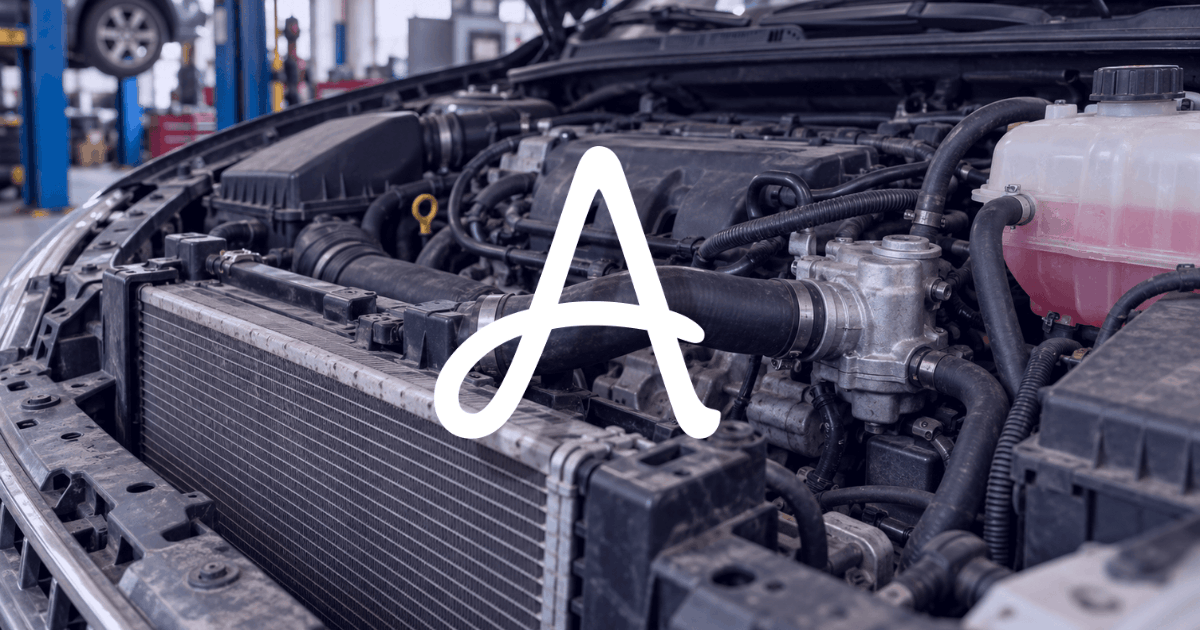
The car cooling system carries excess heat away from the engine and releases it into the air. Coolant transports that heat, the water pump keeps it moving, the thermostat regulates flow through the radiator, and the cooling fan supplies airflow when needed. Together, these parts help the engine reach and maintain its intended operating temperature.
This guide covers conventional liquid-cooled petrol and diesel engines. Exact layouts and procedures vary by vehicle, so use your owner’s manual for coolant specifications, warning messages and service instructions.
How a car cooling system works
Think of the system as a repeating heat-transfer loop:
- Collect heat: coolant flows through passages in the engine block and cylinder head, absorbing heat from the surrounding metal.
- Control the route: while the engine warms up, the thermostat restricts flow to the radiator. A bypass circuit allows circulation within the engine on typical systems.
- Release heat: as the thermostat opens, hot coolant flows through the radiator, where heat passes into the surrounding air.
- Repeat: the pump circulates the cooled fluid back through the engine.
This is a simplified description rather than a universal plumbing diagram. Modern engines may use electric pumps, electronically controlled thermostats and several coolant circuits.
What each cooling-system component does
Car radiator: transfers heat to the air
The car radiator is a heat exchanger, usually mounted near the front of the vehicle. Coolant passes through narrow tubes, while metal fins provide a large surface for transferring heat into the air. Vehicle movement provides airflow; a cooling fan helps when road speed is low or the car is stationary.
The radiator needs both coolant flow inside and airflow outside. A restriction on either side can reduce its ability to remove heat. It is a different component from the air-conditioning condenser, even though the two may sit close together.
For a comparison with a different cooling arrangement, see how marine and automotive engines differ.
Coolant: carries heat and protects the system
Engine coolant is typically a specified mixture of water, glycol and protective additives. It transfers heat and provides protection against freezing and corrosion. The mixture also affects boiling protection, so plain water is not an equivalent long-term replacement.
Choose coolant by the vehicle manufacturer’s specification, not just its colour. Two products that look alike may use different additive technologies. Avoid mixing products unless compatibility is explicitly confirmed for the application.
Ready-mixed coolant is supplied at its intended concentration. Concentrate needs dilution with the specified water quality and ratio. Do not assume stronger concentrate gives better cooling, or add water to premix without checking the instructions.
Thermostat: controls warm-up and operating temperature
The thermostat is a temperature-responsive valve. It limits radiator flow when the engine is cold, then progressively permits more flow as temperature rises. Many conventional designs use a wax element; some add electrical control.
A thermostat that fails closed can restrict heat removal and cause overheating. One that remains open may make the engine warm up slowly or run cooler than intended. Removing it is not a proper repair: replace a faulty unit with the specified part.
Water pump: circulates the coolant
Despite its name, the water pump normally moves the specified coolant mixture. Depending on the engine, it may be driven mechanically or electrically. A leak, damaged impeller or drive fault can reduce circulation even when the reservoir contains fluid.
Fan, hoses, reservoir and pressure cap
Hoses connect the circuit, while a reservoir accommodates changes in coolant volume as temperature changes. Some cars have a pressurised expansion tank; others use a separate recovery bottle. Follow the manual to identify the correct checking and filling point.
The specified pressure cap helps maintain system pressure, which raises the coolant’s boiling point. A faulty cap can compromise that protection. Never substitute a higher-pressure cap as an overheating fix.
Electric fans can start automatically, sometimes even after the engine is switched off. Keep hands, clothing and tools clear.
Why temperature control matters for engine performance
The aim is to keep the engine within its designed temperature range. Excessive heat can damage components, while running too cool can affect efficiency and emissions. Correct temperature control supports consistent engine performance; it is not a promise of extra horsepower.
Coolant is only part of heat management. Engine oil also carries heat away from components while lubricating moving surfaces. Our guide to why engines need different oil types explains why the specified lubricant matters too.
Why a car overheats: clues and possible causes
A high-temperature warning tells you to act, but it does not identify the failed part. These patterns can help describe the problem to a workshop.
| What you notice | What may need checking |
|---|---|
| Temperature rises mainly in slow traffic | Cooling fan operation, its controls and airflow through the radiator. |
| Coolant level repeatedly falls when checked cold | Leaks at hoses, radiator, pump, tank or cap, and possible internal leakage. |
| Overheating continues with enough coolant in the reservoir | Thermostat operation, pump circulation, radiator restrictions or trapped air. |
| Trouble starts after cooling-system work | Correct filling, leak checks and the vehicle-specific air-bleeding procedure. |
These are possibilities, not diagnoses. A full reservoir does not prove that the entire circuit is full or circulating correctly. A workshop may need to test system pressure, fan operation and coolant flow before recommending parts.
What to do if the engine overheats
- Stop safely. If the temperature warning appears or the gauge enters its warning range, pull over as soon as it is safe. Turn off the air conditioning and secure the vehicle.
- Respond to steam or leakage immediately. Switch off the engine if steam or coolant is escaping. Do not open the bonnet while steam is coming out. Follow the vehicle’s overheating instructions; if you are unsure, switch off and call roadside assistance.
- Leave hot caps alone. Never remove a radiator or pressurised coolant-reservoir cap while the system is hot. Escaping coolant and steam can cause serious burns.
- Arrange help when the cause is unclear. Do not keep restarting or driving with an overheating warning. Significant coolant loss or repeated overheating needs inspection and may require recovery.
Only check or replenish coolant after the engine has cooled fully and according to the manual. Adding fluid does not repair a leak, and suddenly adding cold fluid to an overheated engine can cause damage.
Cooling-system maintenance checks
- Check the cold level: park on level ground and compare the reservoir level with the specified cold markings. Do not fill above the recommended level.
- Watch for changes: recurring coolant loss, staining around joints or visible leaks deserve investigation rather than repeated topping up.
- Use the correct fluid: confirm specification, concentration and compatibility before adding coolant.
- Follow the service schedule: coolant replacement intervals depend on the vehicle and coolant. There is no single interval suitable for every car.
- Check the whole system during service: ask for inspection of hoses, connections, the pressure cap, pump and radiator, particularly if symptoms have appeared.
- Refill correctly after repairs: trapped air can affect circulation. Bleeding procedures vary and may require workshop equipment.
Frequently asked questions
Do cars in hot climates still need antifreeze coolant?
Yes. The specified coolant provides corrosion and boiling protection as well as freeze protection. Living somewhere warm does not make plain water a suitable routine substitute.
Can a car overheat even when the coolant tank is full?
Yes. The system also needs proper circulation and airflow. A thermostat, pump, fan or radiator problem can cause overheating without an obviously empty reservoir.
Should the radiator fan run all the time?
Not necessarily. Many electric fans switch on or vary speed according to cooling demand. A stationary fan on a cold engine does not by itself prove a fault; its behaviour must be assessed against the vehicle’s control strategy.
How often should coolant be changed?
Use the time or distance interval in your vehicle’s maintenance schedule, together with its coolant specification. If the coolant history is unknown or the system is contaminated, ask a workshop to assess it rather than choosing an arbitrary interval.
