



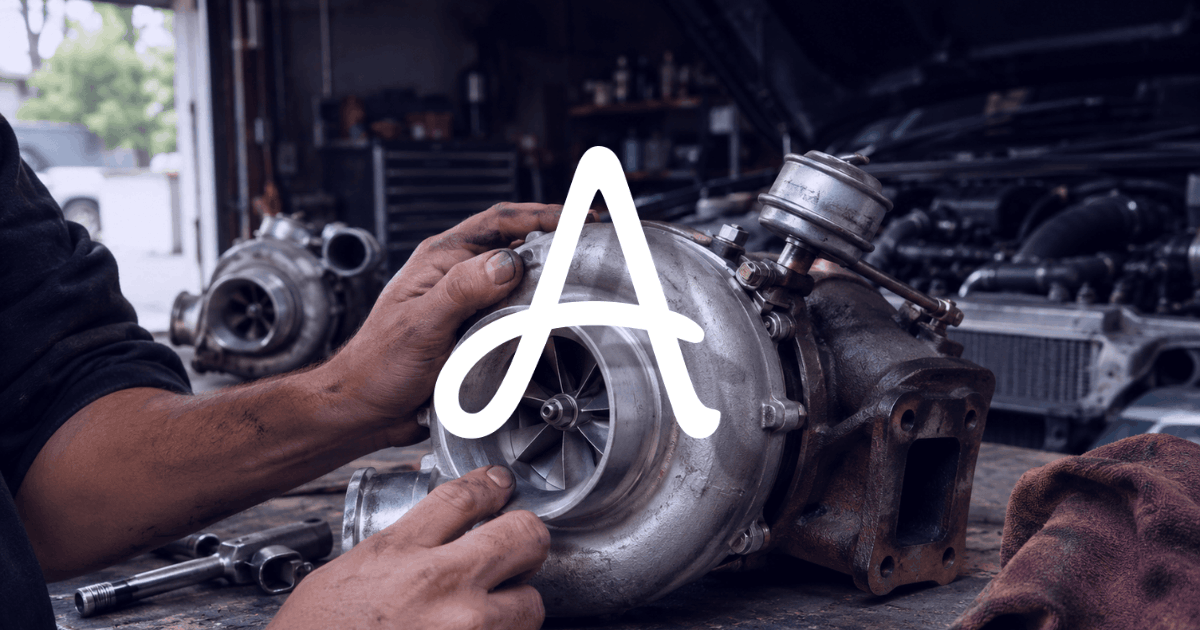
Turbo lag explained simply: it is the delay between asking a turbocharged engine for more power and the turbo building the extra boost needed to deliver it. The engine can respond before full boost arrives, so lag often feels like modest acceleration followed by a stronger surge.
The main reasons are the time needed to accelerate the turbo’s rotating parts, the exhaust energy available to drive them, and how well the turbo and its airflow system suit the engine. Better turbo design can shorten the delay. Choosing an appropriate gear can also improve the response you feel, while repairing leaks or control faults can restore performance that has deteriorated.
How a turbocharger builds boost
A turbocharger has an exhaust-driven turbine connected by a shaft to an intake compressor. The compressor raises the pressure of the incoming air, allowing the engine to burn more fuel and produce more power. Our guide to turbochargers, superchargers and forced induction explains that basic difference in more detail.
When you request more power, the turbine needs enough exhaust energy to accelerate the shaft and compressor. Boost then builds through the intake system. These changes take time, particularly when starting from low engine load.
The turbo does not suddenly switch on at a fixed RPM. It can already be spinning without producing substantial boost. Engine speed, load and the turbo system’s design all influence what happens next.
Turbo lag versus boost threshold
Turbo lag is a time delay. Boost threshold describes the operating conditions, often discussed in terms of engine RPM, at which useful boost becomes available. They are related, but different.
Imagine accelerating in a high gear at very low RPM. The engine may initially be below the range where it can sustain much boost. As RPM rises, stronger acceleration arrives. That experience can combine boost threshold with the turbo’s spool-up delay.
A wait for an automatic gearbox to downshift can add another pause. Pedal mapping and traction control can also affect vehicle response. A hesitation at the accelerator is therefore not, by itself, proof of turbo lag.
What causes turbo lag?
1. Limited exhaust energy at the starting point
A conventional turbo relies on energy in the exhaust. At low engine speed and light load, less energy is available to accelerate the turbine. A sudden demand for strong acceleration from those conditions can expose a noticeable delay.
This is why two acceleration attempts in the same car can feel different. Starting in a suitable lower gear changes the engine’s operating conditions before you ask for more power.
2. The inertia of the rotating assembly
The turbine wheel, shaft and compressor wheel resist changes in speed. This rotational inertia means the assembly cannot instantly jump to the speed required for higher boost. Wheel design, materials and bearing losses all influence response.
3. A turbo chosen for a different performance priority
A turbo sized mainly for high peak power can respond more slowly than a smaller unit matched to everyday driving. Turbine housing size also matters: a smaller passage can favour earlier boost, while a larger one can accommodate more exhaust flow at high engine speeds.
There is a trade-off. Simply fitting the smallest turbo is not the answer, because it may restrict the airflow needed for the engine’s intended power output.
4. The intake, exhaust and boost-control system
The turbo works as part of a complete system. Charge-pipe volume, intercooler design and flow restrictions affect how boost reaches the engine. Oversized piping can slow response, while undersized piping can create excessive pressure loss.
Boost control matters too. On a wastegated turbo, a valve bypasses some exhaust around the turbine to regulate turbo speed and boost. Its control strategy influences how boost develops. A leak or actuator fault can make a healthy design feel unusually sluggish.
How to reduce turbo lag in everyday driving
Separate three goals: improving the response you feel, restoring lost performance, and changing the engine’s hardware. They call for different actions.
- Use an appropriate gear. If the engine is struggling at low RPM, a suitable downshift can move it into a more responsive operating range. Follow the handbook and avoid over-revving. This changes the starting conditions; it does not remove the turbo’s inertia.
- Allow for the car’s response. Select a suitable gear before an acceleration manoeuvre rather than relying on a sudden boost surge. Leave enough space and time for the vehicle to respond.
- Investigate a change from normal. If response has become worse, have the intake and charge-air system, filters and boost controls checked. New warning lights, smoke, unusual noise or persistent power loss deserve diagnosis rather than being dismissed as normal lag.
- Follow the correct maintenance requirements. Suitable oil and servicing help protect the turbo. Our guide to choosing the right engine oil explains why the manufacturer’s specification matters. Oil changes cannot turn a slow-spooling turbo into a different design.
For a modified vehicle, reducing lag requires matching the turbo, turbine housing, manifolds, intercooler, piping and engine calibration to the intended use. A larger turbo or intercooler is not automatically a response upgrade. Increasing a boost target alone does not establish that boost will arrive sooner.
Which turbocharger designs can deliver less lag?
Several technologies improve response in different ways. They are not all competing turbo types: one installation can combine a twin-scroll housing, a low-inertia rotating assembly and ball bearings.
Variable geometry turbocharger: VGT, VNT and VTG
A variable geometry turbocharger changes the effective passage directing exhaust onto the turbine, usually with movable vanes. VNT and VTG are names readers may encounter for variable geometry designs.
At low exhaust flow, narrowing the passage helps the turbine extract energy effectively. As flow increases, the vanes open to accommodate it. This reduces the compromise of a fixed turbine passage, improving low-speed boost and response across a wider operating range.
Variable geometry is well established on diesel engines, but it is not diesel-only technology. Petrol applications also exist, with designs and materials suited to their exhaust temperatures. The vane mechanism adds complexity, and variable geometry does not guarantee zero lag.
Twin-scroll turbocharger
A twin-scroll turbocharger uses two separate exhaust passages feeding one turbine. A correctly paired, divided exhaust manifold keeps cylinder pulses separated so their energy can drive the turbine more effectively.
This can improve spool-up and boost response, especially at low and medium engine speeds. It needs the appropriate manifold and cylinder pairing to work as intended. Twin-scroll means two passages in one turbo, not two turbochargers.
Smaller, low-inertia and ball-bearing turbos
An appropriately sized, low-inertia turbo can accelerate its rotating assembly quickly. Ball bearings can reduce bearing power losses and improve response too.
These features still need to suit the engine’s airflow and power requirements. A bearing upgrade cannot compensate for every mismatch between a large turbo and a small engine.
Sequential and regulated two-stage turbo systems
Some systems use multiple turbochargers and controlled exhaust or intake paths to provide useful boost across a broad operating range. A responsive smaller stage can help at low flow, while the overall arrangement supports greater airflow as demand increases.
The plumbing and control sequence vary. Sequential and series two-stage systems should not be treated as identical, and a twin-turbo badge alone does not establish low lag. Two turbos operating in parallel are another arrangement, whose response depends on their sizing and installation.
Electric turbocharger and separate electric compressor
An electrically assisted turbo, often called an electric turbocharger, uses a motor to add torque to the turbo shaft. It can accelerate the compressor while exhaust energy is still building, directly addressing an important cause of lag.
A separate electric compressor takes a different approach: it supplies compressed air within the intake system, supplementing a conventional turbocharger. It does not need to be mounted on the turbo shaft. Both approaches require a suitable electrical supply and coordinated controls.
An electrically operated wastegate is different again. Its motor moves a boost-control valve; it does not electrically spin the turbo.
| Technology | Main response benefit | Key consideration |
|---|---|---|
| Variable geometry | Adapts turbine flow area to operating conditions | Vane control, materials and engine calibration |
| Twin-scroll | Uses separated exhaust pulses effectively | Correct manifold design and cylinder pairing |
| Low-inertia or ball-bearing turbo | Reduces inertia or bearing losses | Airflow capacity must still match the engine |
| Sequential or two-stage system | Broadens useful boost delivery | More complex plumbing and stage control |
| Electrically assisted turbo | Adds shaft torque before exhaust energy builds | Electrical power and control requirements |
No label identifies the lowest-lag option in every vehicle. The complete engine and transmission package determines the response a driver experiences.
What about motorsport anti-lag?
Motorsport anti-lag uses engine-control strategies to maintain turbine speed when the driver lifts off the accelerator. Depending on the system, this can involve ignition and airflow changes that keep energy reaching the turbine.
It places demanding loads on the hardware. Anti-lag controls can include temperature, operating-time and turbo-speed limits to prevent damage. It is a specialised engineered system, rather than a routine fix for a road car that feels slow to respond.
Frequently asked questions
At what RPM does turbo lag end?
There is no universal RPM. Useful boost depends on engine load, speed, turbo sizing and control strategy. Even within an engine’s strong operating range, a change in demand can involve some boost-building delay.
Does a variable geometry turbocharger eliminate turbo lag?
No. Adjusting the turbine passage can improve low-speed response, but the rotating assembly and intake system still need time to respond. The result depends on the complete engine design and its operating conditions.
Is twin-scroll better than twin-turbo for reducing lag?
The names describe different things. Twin-scroll describes divided exhaust passages in a turbo; twin-turbo describes an installation with two turbochargers. Their response cannot be ranked from those labels alone.
Can a remap remove turbo lag?
Calibration can alter boost control and torque delivery, but it cannot remove the rotating assembly’s inertia or guarantee instant boost. Any change needs to account for the turbo’s limits and the engine’s protection requirements.
