



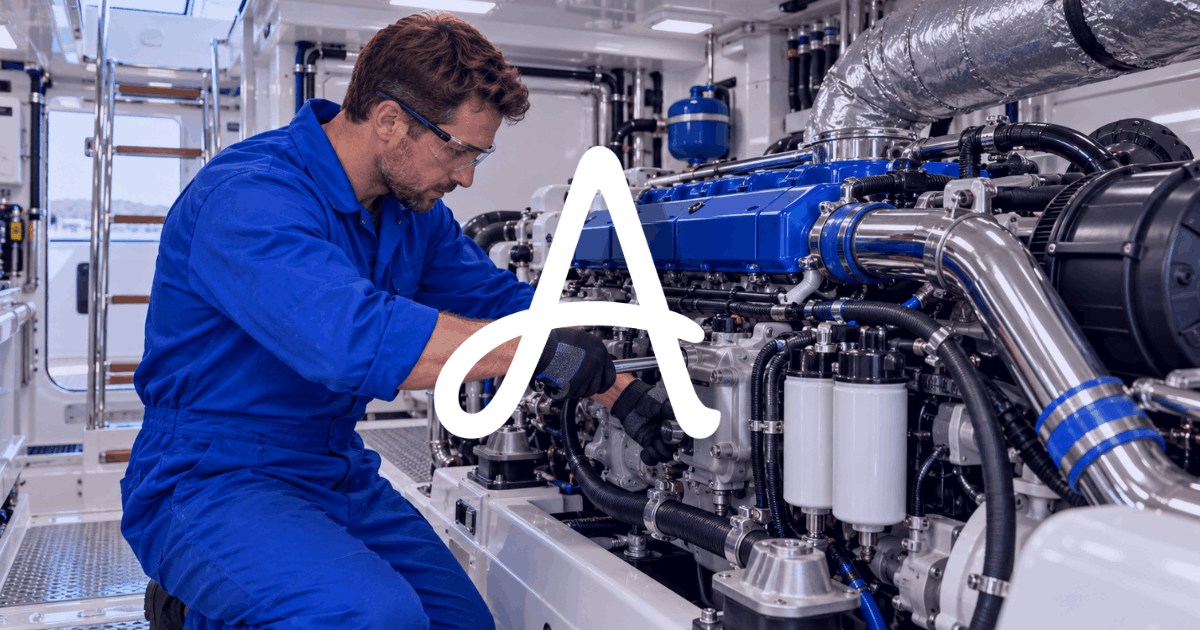
A marine engine and an automotive engine may use the same basic combustion cycle, but they are built for very different working environments. A marine engine must cope with sustained propeller load, limited airflow, saltwater exposure, vessel-specific cooling and exhaust systems, and a marine transmission. Those differences affect its design, rating, installation, and maintenance.
This guide focuses mainly on inboard engines used for propulsion. Outboards, sterndrives, large slow-speed ship engines, and generator sets use different layouts, but the same principle applies: a marine power unit is an engine and its supporting systems engineered for service on the water.
Marine Engine vs Automotive Engine at a Glance
| Area | Marine engine | Automotive engine |
|---|---|---|
| Cooling | Often uses a closed coolant circuit and a seawater-fed heat exchanger, or a keel-cooling system | Usually uses a closed coolant circuit and an air-cooled radiator |
| Typical load | May run for long periods at a high, steady load set by the propeller and vessel | Load changes frequently with traffic, speed, gears, gradients, and braking |
| Corrosion protection | Designed for humid, freshwater, or saltwater exposure with marine-grade materials and protective systems | Protected against road weather and splash, but not designed for continuous marine exposure |
| Exhaust | May use a wet exhaust that mixes cooling water with exhaust gas downstream of the engine | Uses a dry exhaust routed through catalytic converters and silencers |
| Power delivery | Drives a propeller through a marine gear, shaft, saildrive, sterndrive, or waterjet | Drives wheels through a clutch or torque converter, transmission, differential, and axles |
| Service measurement | Maintenance is commonly scheduled by operating hours and duty | Maintenance is commonly scheduled by distance, time, and operating conditions |
What Makes a Marine Engine Different?
1. The cooling system uses the surrounding water
A car releases engine heat through a radiator, with airflow provided by vehicle motion and an electric or belt-driven fan. A boat cannot depend on that arrangement inside an enclosed engine compartment.
Many marine engines circulate treated coolant through the engine and pass it through a heat exchanger. A separate raw-water pump draws seawater or lake water through a strainer and the other side of the heat exchanger before discharging it, often through the exhaust. Some small engines use direct raw-water cooling, while some commercial installations use keel cooling instead.
This design adds marine-specific service items such as the raw-water impeller, intake strainer, heat exchanger, hoses, anti-siphon components, and sacrificial anodes. A blocked intake or damaged impeller can quickly cause overheating.
2. The duty cycle can be much more demanding
A road vehicle rarely stays at one high engine load for hours. Its engine load falls when the driver changes gear, slows down, coasts, or stops. A propeller creates a load that rises sharply with speed, so a propulsion engine can spend long periods working hard.
Marine manufacturers therefore publish different duty ratings. A recreational high-output rating may allow full power only for limited periods, while a continuous-duty rating is intended for long, heavily loaded marine operations. Choosing an engine by peak horsepower alone can lead to poor durability if its rating does not match the vessel’s real operating profile.
3. Corrosion protection is part of the design
Humidity, salt spray, bilge water, and electrical contact between dissimilar metals create a harsh environment. Marine engines and drives may use corrosion-resistant alloys, protective coatings, marine-grade wiring and connectors, and replaceable sacrificial anodes. The exact protection depends on whether the vessel operates in freshwater, brackish water, or saltwater.
An automotive engine may share a basic block design with a marinized version, but its external parts, electrical equipment, cooling passages, and fasteners are not automatically suitable for a boat.
4. The exhaust system must work safely inside a vessel
Cars send hot exhaust through a dry pipe under the vehicle. Many boats use a wet exhaust system in which raw cooling water is injected into the exhaust after the exhaust manifold or riser. This cools the gas and lets rubber exhaust hose be used farther downstream.
The layout must also prevent water from flowing back into the engine. Exhaust riser height, hose routing, waterlocks, and anti-siphon devices are installation-critical. Some commercial vessels use dry exhaust systems instead, so wet exhaust is common rather than universal.
5. A marine gear replaces the road transmission
A boat does not need multiple road-speed ratios in the same way a car does. An inboard engine commonly connects to a marine gear that provides neutral, forward and reverse, and a reduction ratio that matches engine speed to the propeller. The propeller, gear ratio, hull, and engine must be matched as a system.
This is why an engine that produces suitable power on a test stand can still perform poorly in a boat if it is paired with the wrong propeller or reduction ratio.
6. Installation and safety systems are vessel-specific
A marine engine works in a confined compartment where ventilation, heat management, fuel routing, electrical protection, engine mounts, shaft alignment, and access for maintenance all matter. Gasoline installations need particular attention to fuel vapour and ignition protection. Requirements vary by vessel type and jurisdiction, so an installation must follow the engine maker’s instructions and applicable marine standards.
7. Marine engines follow different certification rules
Road and marine engines are regulated under different test cycles and emissions frameworks. In the United States, marine compression-ignition engines fall under marine-specific EPA rules. Internationally operated vessels may also be subject to MARPOL Annex VI requirements. Compliance therefore depends on the engine category, power, displacement, vessel use, location, and build date.
Are Marine Diesel Engines Basically Car Diesels?
The combustion process is familiar: both use compression ignition, fuel injection, pistons, connecting rods, and a crankshaft. Some manufacturers also adapt a common engine family for several applications. The finished products are not interchangeable, however.
Marine diesel engines are configured around a vessel’s cooling, exhaust, power rating, gear, controls, electrical system, mounting, and corrosion requirements. Their calibration and rated output may also differ from an automotive version. Two engines with similar displacement can therefore have different power curves, service intervals, and allowable duty.
For a wider overview of combustion and electric power units, see our guide to different types of engine.
Why Are Diesel Engines Common in Marine Operations?
Diesel engines are widely used for inboard propulsion because they can be configured for efficient operation under sustained load, offer strong low-speed pulling power, and are available in duty ratings ranging from recreational to continuous commercial service. Diesel fuel is also less volatile than petrol.
That does not make diesel the only marine choice. Petrol engines remain common in outboards and performance-focused leisure boats, while gas turbines, electric motors, hybrid systems, and alternative fuels serve particular vessel types.
Can You Put an Automotive Engine in a Boat?
Not safely by simply moving the engine from one vehicle to another. A proper conversion requires engineered cooling and exhaust systems, suitable fuel and electrical components, corrosion protection, a marine gear or drive, correct mounts, controls, ventilation, and a propeller match. It may also need certification for the vessel and market.
A professionally marinized engine package is usually the more practical route because its components and rating have been validated together. A conversion should be designed and checked by a qualified marine engineer or installer.
How Marine Engine Maintenance Differs
Routine engine oil, filter, belt, and coolant work may look familiar. Marine service also includes checks that a car does not have:
- Inspect and clean the raw-water intake strainer.
- Check the seawater pump impeller and carry the correct spare.
- Inspect heat exchangers, coolers, anodes, and raw-water hoses.
- Look for corrosion, salt deposits, fuel leaks, and water leaks.
- Inspect wet-exhaust hoses, clamps, risers, and waterlocks.
- Check engine mounts, shaft alignment, coupling, and marine gear oil.
- Follow the maker’s flushing and lay-up procedure when required.
Use the maintenance schedule for the exact engine model and duty. Oil specifications and service intervals should come from the engine manufacturer, not from a visually similar automotive engine. Our explainer on why engines need different oil types provides useful background on lubricant selection.
Frequently Asked Questions
Is a marine engine just a car engine with different accessories?
No. Some marine and automotive engines may share a basic architecture, but a complete marine engine package has application-specific cooling, exhaust, electrical, corrosion-protection, mounting, control, and power-rating requirements.
Do marine engines produce more torque than automotive engines?
Not in every case. Marine propulsion systems are selected to deliver the required shaft power and propeller speed for a vessel. Diesel models often provide strong torque, but engine output, reduction ratio, and propeller design must be considered together.
Why do marine engines use a heat exchanger?
A heat exchanger transfers heat from the engine’s closed coolant circuit to a seawater or lake-water circuit. This lets the engine use treated coolant while the surrounding water carries heat away from the vessel.
Do marine engines need special oil?
They need oil that meets the engine manufacturer’s specification and suits the operating duty. Some specifications overlap with automotive oils, while others do not. Always use the viscosity and performance standard stated in the marine engine manual.
