



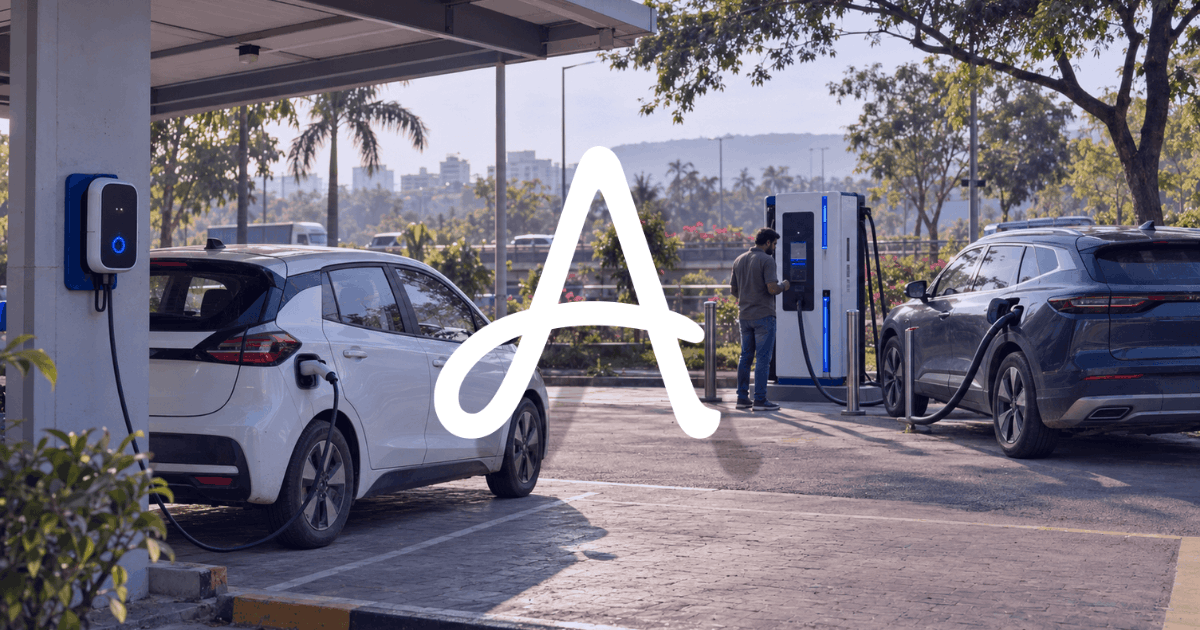
AC charging is usually the best choice for routine home or workplace charging, while DC charging is designed for faster top-ups during long trips or when time is limited. The important difference is where alternating current is converted into the direct current stored by the battery. With AC charging, the car’s onboard charger performs the conversion. With DC charging, the charging station does it before sending power to the battery.
That difference affects charging speed, connector type, installation requirements and cost. It also explains why a charger’s advertised power does not always equal the power your EV receives.
AC vs DC EV Charging at a glance
| Factor | AC charging | DC charging |
|---|---|---|
| Power conversion | Inside the vehicle through its onboard charger | Inside the charging station |
| Typical role | Home, apartment, office and destination charging | Highway stops, fleet hubs and quick public charging |
| Speed | Usually measured in hours | Often adds a useful charge in tens of minutes |
| Common car connector in India | Type 2 on many current models | CCS2 on many current models |
| Main power limit | Supply, EVSE and the car’s onboard charger | Station output, the car’s DC limit and battery conditions |
| Best use | Regular charging while the vehicle is parked | Time-sensitive charging away from home |
How AC charging works
Electricity supplied by the grid is AC, but an EV battery stores DC energy. During AC charging, the charge point provides controlled AC power to the vehicle. The vehicle’s onboard charger then converts it to DC and manages the flow into the battery.
This makes the onboard charger a key limit. For example, an EV with a 7.2 kW onboard charger cannot draw 11 kW from an 11 kW AC charge point. Its peak AC input will remain around the lower vehicle limit, subject to operating conditions.
Common AC options for electric cars in India include:
- Portable charging from a suitable socket: Often around 2.8 to 3.3 kW, depending on the vehicle, cable and electrical supply.
- Single-phase wallbox: Common ratings include 7.2 or 7.4 kW.
- Three-phase wallbox: Some vehicles and properties can support 11 kW or more, but the car and electrical connection must both be compatible.
A portable charger should be connected only to a properly rated, earthed circuit that has been checked by a qualified electrician. Extension boards and improvised adapters can overheat and should not be used for routine EV charging.
How DC fast charging works
A DC charger contains high-power conversion equipment outside the vehicle. It converts grid AC into controlled DC and supplies it through the vehicle’s DC charging inlet. Because it bypasses the car’s onboard AC charger, it can deliver much more power than most home wallboxes.
Public DC chargers range from units delivering tens of kilowatts to high-power equipment rated at 100 kW or more. The car does not automatically accept the station’s full rating. The charging session is limited by whichever is lower:
- The charger’s available output
- The vehicle’s maximum DC charging rate
- The battery management system’s current limit
- Battery temperature and state of charge
- Power sharing between multiple charging bays
DC charging normally follows a charging curve rather than maintaining one speed. Power may rise after the session starts, reach a peak and then fall as the battery fills. The slowdown is usually more noticeable above about 80 percent, although the exact behaviour depends on the vehicle.
AC vs DC EV charging speeds in India
Charging time depends on battery capacity and the amount of energy that must be added, not just the charger’s headline rating. A useful first estimate is:
Charging time in hours = energy required in kWh ÷ charging power in kW
Consider an EV with a 40 kWh battery charging from 20 to 80 percent. It needs roughly 24 kWh before losses. At a constant 3.3 kW, the ideal calculation is about 7.3 hours. At 7.4 kW, it is about 3.2 hours. At a constant 60 kW, it would be 24 minutes.
Real sessions take longer because AC conversion has losses and DC power changes during the charging curve. A cold or hot battery, a busy charging station and the vehicle’s own limits can also extend the time. Treat calculated figures as planning estimates, then check the manufacturer’s charging specifications for your exact variant.
EV charging connectors used in India
Connector compatibility matters as much as charging speed. A high-power EV charging station is useful only if its plug matches the vehicle and supports the required charging standard.
Type 2 for AC charging
Type 2 is widely used for AC charging on current electric cars in India. It can support single-phase or three-phase charging, but the usable rate depends on the charge point, cable and vehicle. Some public AC stations have a socket that requires the driver’s own Type 2 cable, while others have a tethered cable.
CCS2 for DC charging
CCS2, also called Combo 2, is the common DC fast-charging interface on many current electric cars sold in India. It combines the upper Type 2-style section with two larger DC pins below it. The Bureau of Indian Standards covers AC, DC and combined couplers within the IS 17017 series.
Do not assume that every EV with a Type 2 AC inlet can use CCS2. A CCS2 vehicle inlet has the additional DC contacts and the vehicle must support the required communication and charging protocol.
Bharat AC-001 and Bharat DC-001
Some older charging infrastructure may use Bharat charger specifications. Bharat AC-001 was designed around lower-power AC charging, while Bharat DC-001 commonly refers to a lower-power DC system associated with the GB/T interface. These may still appear at legacy locations or support certain older vehicles, but compatibility should be checked in the vehicle manual or charging app.
CHAdeMO and other car connectors
CHAdeMO can still appear at some older multi-standard DC stations, but CCS2 is the more relevant connector for many current Indian electric cars. Older or imported models may differ, so the charging port on the specific vehicle should be confirmed before planning a route.
Electric two-wheelers and three-wheelers
Electric scooters, motorcycles and three-wheelers do not all use the same inlet. Some use portable chargers connected to a standard AC supply, some use manufacturer-specific connectors, and newer light-EV systems may follow Indian LEV charging standards. Never select a station based only on its power rating. Check the plug, voltage, communication standard and manufacturer guidance.
When AC charging is the better choice
Choose AC charging when the vehicle will remain parked long enough to recover the energy used during the day. It suits:
- Overnight home charging
- Workplace charging during office hours
- Apartment or housing-society parking
- Hotels, malls and other destinations with longer dwell times
- Regular charging when the next journey is predictable
AC charging is often more convenient for daily use because the car charges while it would otherwise be stationary. It can also reduce dependence on public charging infrastructure. Before installing a wallbox, confirm the sanctioned electrical load, earthing, cable size, protective devices and any apartment or distribution-company requirements.
When DC charging is the better choice
Use DC charging when time matters more than leaving the vehicle parked for several hours. It is most useful for:
- Highway journeys
- Rapid top-ups between appointments
- Commercial vehicles with short turnaround times
- Drivers without reliable home or workplace charging
- Unexpected trips when the battery is low
On a road trip, charging only to the level needed for the next reliable stop can be quicker than waiting for 100 percent. Since many EVs reduce DC power at a high state of charge, two shorter stops may sometimes be faster than one session that continues deep into the taper. Route planning should account for connector compatibility, charger status, payment access and a backup station.
Does frequent DC charging damage an EV battery?
DC charging is a normal capability designed into compatible EVs. However, high charging power can create more heat, and battery temperature is one factor that affects ageing. Modern battery management systems reduce power when necessary to protect the battery.
For routine use, AC charging is a sensible default when it meets the driver’s schedule. DC charging remains useful when its time saving matters. Owners should follow the vehicle manufacturer’s charging and storage guidance instead of relying on a universal rule for every battery. Our guide to lithium-ion battery technology explains the battery basics in more detail.
How to choose an EV charging station
Before starting a session, check:
- Connector: Confirm Type 2, CCS2 or the standard required by the vehicle.
- Vehicle limit: Compare the car’s maximum AC or DC rate with the charger rating.
- Availability: Use a reliable app or operator listing to check status and access hours.
- Tariff: Review the billing unit, session fee, parking charge and idle fee.
- Location: Prefer a safe, well-lit site with a backup charger nearby.
- Battery target: Decide how much energy is needed for the next leg instead of always aiming for 100 percent.
If you are still deciding whether an EV fits your driving pattern, review these considerations before buying an electric car in India.
AC vs DC EV Charging: which should you use?
For most Indian EV owners, AC and DC charging are complementary rather than competing choices. Use AC at home or work for predictable daily charging. Use DC on highways and on days when a faster stop is worth the higher infrastructure and service cost.
The simplest routine is to begin each day with enough charge from an AC source and reserve DC charging for travel or urgent top-ups. Always match the connector and charging rate to the exact vehicle, because a larger number on the station cannot override the car’s limits.
Frequently asked questions
Can I charge an EV with both AC and DC power?
Many electric cars support both AC and DC charging through a combined inlet arrangement, but not every EV does. Some low-speed or light electric vehicles support only AC charging or use a manufacturer-specific system. Check the owner’s manual and the labels near the charging port.
Is a 60 kW DC charger twice as fast as a 30 kW charger?
Not always. It can be close to twice as fast only while the vehicle can accept the higher power and both chargers can deliver their ratings. Battery temperature, state of charge, the vehicle’s DC limit and the charging curve can reduce the difference.
Can I install a DC fast charger at home in India?
It is technically possible in some properties, but it is usually impractical for a home because of the required electrical capacity, equipment cost, approvals and installation work. A properly specified AC wallbox is the more suitable home solution for most private cars.
Why does DC charging slow down near 80 percent?
The battery management system reduces current as the battery approaches a high state of charge to control cell voltage and temperature. The exact point and rate of slowdown vary by model, battery condition and operating temperature.
