



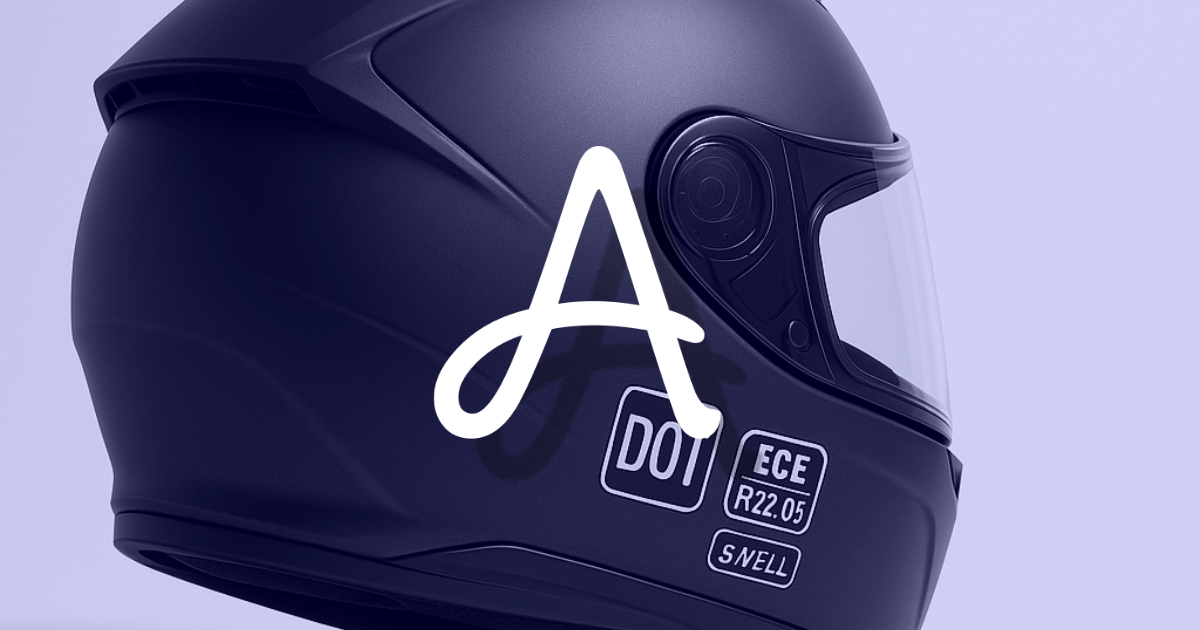
As a rider, you know a helmet is the single most important piece of gear you own. It’s not just about avoiding a traffic ticket; it’s about protecting your life. But how do you know if the helmet you’re buying is actually up to the task? A cool graphic or a high price tag doesn’t guarantee safety. The real proof lies in a small sticker on the back: the safety certification.
Choosing a helmet with the right safety rating is the most critical part of your purchase, second only to getting the perfect fit . These certifications aren’t just fancy labels; they are your assurance that the helmet has been subjected to rigorous testing to protect you when you need it most.
This guide will break down the world of helmet certifications—from DOT and ECE to SNELL and beyond—so you can understand what they mean and make an informed decision for your safety .
Why Do Helmet Certifications Matter?
A helmet has one primary job: to absorb and dissipate the energy of an impact to reduce the force transferred to your head and brain. Helmet certification bodies are independent organizations that set minimum safety standards and test helmets to ensure they perform this job effectively.
These tests simulate real-world crash scenarios and typically evaluate:
- Impact Absorption: How well the helmet absorbs shock from a direct hit.
- Penetration Resistance: The shell’s ability to resist being pierced by a sharp object.
- Retention System Strength: The chin strap’s ability to keep the helmet securely on your head during a crash.
- Field of Vision: Ensuring the helmet doesn’t obstruct the rider’s peripheral view.
Without a certification, a helmet is just a piece of plastic. With one, it’s a scientifically tested piece of life-saving equipment.
The Major Helmet Certifications: A Breakdown
You’ll encounter several acronyms when shopping for a helmet. Let’s decode the most common ones you’ll see in India and around the world .
DOT (Department of Transportation)
The DOT certification is the mandatory legal standard for all motorcycle helmets sold in the United States.
- Who issues it? The U.S. Department of Transportation.
- How it works: The DOT standard is based on an “honour system.” Manufacturers must test their helmets to ensure they meet the minimum requirements (FMVSS 218) before they can apply the DOT sticker. The government then conducts random spot-checks, pulling helmets from the market and testing them. Manufacturers of non-compliant helmets face hefty fines.
- What it tests: Impact absorption, penetration resistance, and retention system effectiveness.
The DOT standard is a solid baseline for safety, but some riders prefer standards with more stringent, third-party testing.
ECE (Economic Commission for Europe)
The ECE 22.06 standard is the most widely recognized helmet certification internationally, required in over 50 countries, primarily in Europe.
- Who issues it? The Economic Commission for Europe.
- How it works: Unlike DOT, ECE requires mandatory batch testing before a helmet can be sold. A sample from the first production batch must be sent to a certified lab for testing. If it passes, the model is certified. No third-party testing, no certification.
- What it tests: The new ECE 22.06 standard is incredibly thorough. It tests everything DOT does, plus a lot more. This includes tests for rotational forces (a major cause of brain injury), visor quality, and multiple impact points at varying speeds.
Many experts consider ECE 22.06 to be one of the most modern and comprehensive standards available today.
SNELL Memorial Foundation
SNELL is a private, non-profit organization in the U.S. that has been setting its own high-performance helmet standards since the 1950s. It is widely regarded as one of the best and most rigorous helmet standards available.
- Who issues it? The SNELL Memorial Foundation.
- How it works: SNELL certification is voluntary, but many high-end helmet brands and all major racing bodies require it. Manufacturers submit their helmets for testing, and SNELL also buys helmets from retailers to ensure ongoing compliance.
- What it tests: SNELL standards are geared towards racing and high-speed performance. Their tests often involve higher-impact forces and multiple hits in the same location. Some critics argue that SNELL-certified helmets can be overly stiff for street riding due to their focus on high G-force impacts However, for track days or competitive racing, SNELL is often considered the gold standard SHARP (Safety Helmet Assessment and Rating Programme)
SHARP is a UK government-funded program that provides a simple, consumer-friendly safety rating for helmets.
- Who issues it? The UK Department for Transport.
- How it works: SHARP buys helmets from retail stores (just like a customer would) and conducts more extensive testing than required by the basic ECE standard. They then award a simple 1-to-5-star rating, making it easy to compare the relative safety of different models.
- What it tests: SHARP conducts 32 impact tests at different speeds and locations on each helmet to assess performance across a wide range of real-world scenarios. Many consider it to be one of the highest helmet certification standards .
ISI (Indian Standards Institute)
For riders in India, the ISI mark is the most important certification. It is illegal to sell a helmet in India without it.
- Who issues it? The Bureau of Indian Standards (BIS).
- How it works: Similar to other national standards, manufacturers must have their helmets tested and certified to meet the IS 4151 standard.
- What it tests: The standard covers basic impact absorption and retention system strength. While essential for legal compliance in India, many riders who prioritize safety often look for helmets that carry dual certification, such as ISI and ECE or DOT, for an added layer of tested protection.
Which Certification is Best?
This is the million-dollar question The truth is, there’s no single “best” certification for everyone.
- For legal road use in India, you must have an ISI-marked helmet.
- For a globally recognized standard with rigorous, modern testing, ECE 22.06 is a top contender.
- For competitive racing or track use, SNELL or FIM (the professional racing standard) is often required and recommended.
- For an easy-to-understand comparison, the SHARP star rating is an excellent resource.
Ultimately, any certified helmet from a reputable brand is infinitely better than a non-certified or fake one The key is to choose a helmet that fits you properly and carries a legitimate certification sticker, ensuring it has been tested to protect you.
Frequently Asked Questions (FAQs)
1. Can I use a helmet with a foreign certification (like ECE) in a country that requires a different one (like DOT or ISI)?
Legally, you are required to use a helmet that meets the mandatory standard for the country you are riding in. For example, in the U.S., a helmet must have a DOT sticker to be street-legal. In India, it must have an ISI mark. While an ECE-certified helmet is extremely safe, you could still be fined if it lacks the required local certification. For maximum safety and legal compliance, look for dual-certified helmets (e.g., ISI and ECE/DOT).
2. Is a more expensive helmet always safer?
Not necessarily. A higher price often gets you premium features like lighter materials (carbon fibre), better ventilation, a more comfortable liner, or advanced aerodynamics—not just a higher safety rating. A mid-range ECE-certified helmet can offer the same level of impact protection as a top-of-the-line model. The certification (DOT, ECE, SNELL) is the guarantee of safety; the price often reflects comfort, features, and brand name.
3. How often should I replace my certified helmet?
Most manufacturers recommend replacing your helmet every 3-5 years, even if it looks fine. Over time, the materials in the helmet, like the EPS foam liner that absorbs impact, degrade due to exposure to sweat, hair oils, and UV light. Crucially, you must replace your helmet immediately after any significant impact or if you drop it from a height of more than a few feet. Even if there’s no visible damage, the internal structure could be compromised, and it will not protect you effectively in a future crash.
