



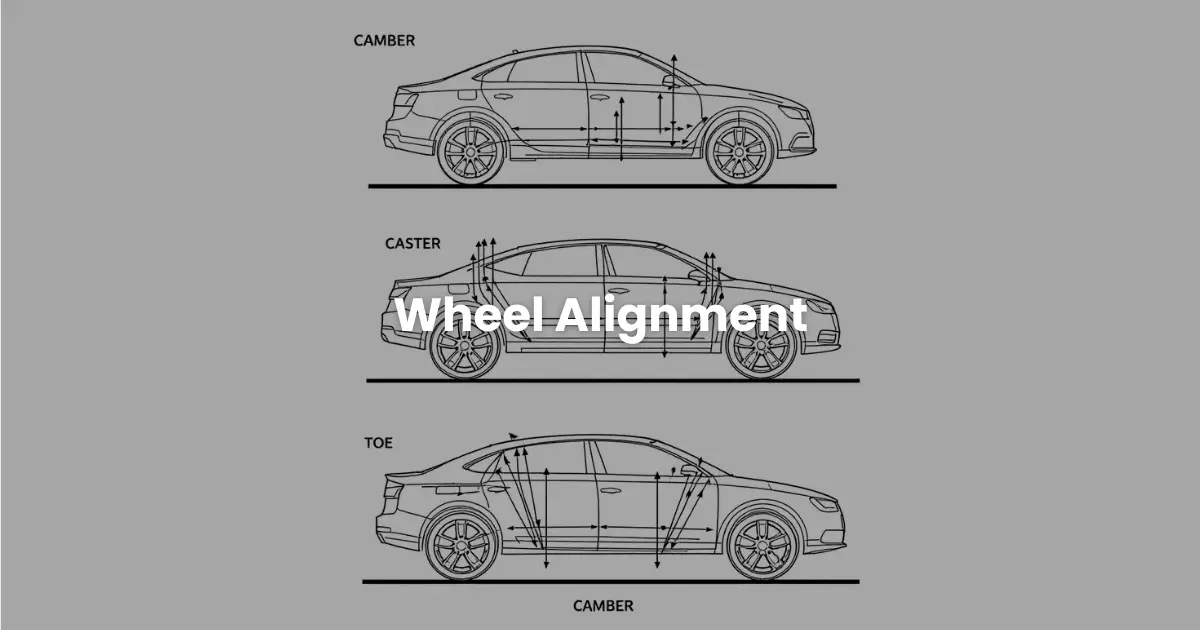
Understanding Camber, Caster, and Toe in Vehicle Alignment
When discussing vehicle maintenance and performance, particularly concerning handling and tire longevity, the terms camber, caster, and toe frequently come up. These three are the most critical wheel alignment parameters in automobile engineering. Understanding what they mean and how they affect your vehicle is vital for ensuring optimal performance, safety, and tire wear proper alignment, considering camber, caster, and toe, ensures your tire tread surface contacts the road as flatly as possible under various driving conditions. Let’s break down each of these essential alignment angles.
What is Camber?
Camber describes the angle of the wheel and tire assembly when viewed from the front of the vehicle. It measures how much the top of the tire tilts inward towards the vehicle’s centre or outward away from it, relative to a perfectly vertical line.
- Positive Camber: The top of the tire tilts away from the centre of the vehicle.
- Negative Camber: The top of the tire tilts inward toward the centre of the vehicle.
What is the Purpose of Camber? / Why Do I Need Camber Angles?
The primary purpose of camber is to optimize the tire’s contact patch with the road surface during cornering and straight-line driving. The “principal of camber” involves setting this angle to manage how the tire behaves under load. While zero camber (perfectly vertical wheel) might seem ideal, slight angles are often necessary.
For instance, negative camber is often used in performance driving setups as it can improve grip during turns. However, excessive camber (either positive or negative) can lead to uneven tire wear and negatively impact handling.
What is Caster?
Caster refers to the angle of the steering axis (the line through the upper and lower ball joints or strut mount and lower ball joint) when viewed from the side of the vehicle. It’s compared to a vertical line drawn through the centre of the wheel.
- Positive Caster: The top of the steering axis tilts rearward, toward the back of the vehicle. This is common in most modern cars.
- Negative Caster: The top of the steering axis tilts forward, toward the front of the vehicle.
Caster primarily affects steering stability, effort, and returnability (the tendency of the steering wheel to return to the centre after a turn). Positive caster generally improves straight-line stability and helps the steering wheel return to centre.
What is Toe Alignment?
Toe describes the direction the front of the tires are pointing when viewed from directly above the vehicle Imagine looking down at your feet – if they point inward, that’s toe-in; if they point outward, that’s toe-out.
- Toe-in: The front edges of the tires point slightly inward, towards each other.
- Toe-out: The front edges of the tires point slightly outward, away from each other.
Effects of Toe Alignment
Toe significantly impacts steering response, straight-line stability, and tire wear Toe-in generally increases stability during straight-line driving but can slightly dull steering response Rear-wheel drive vehicles often use slight toe-in at the rear Toe-out typically improves initial turn-in response but can make the vehicle feel less stable It’s sometimes used on front wheels toe settings are a primary cause of premature tire wear, often resulting in a feathered wear pattern across the tread.
Why are Camber, Caster, and Toe Important?
Collectively, camber, caster, and toe are fundamental aspects of automobile engineering designed to ensure your vehicle handles correctly, drives straight, and maximizes tire life When these angles are set to the manufacturer’s specifications:
- Handling: The vehicle responds predictably to steering inputs.
- Stability: The car tracks straight and remains stable at speed.
- Tire Wear: Tires wear evenly, maximizing their lifespan Fuel Efficiency: Reduced rolling resistance can contribute to better fuel economy.
- Safety: Proper alignment ensures optimal grip and control.
Signs of Misalignment
Your vehicle might need a wheel alignment if you notice:
- Uneven or rapid tire wear.
- The vehicle pulling or drifting to one side.
- The steering wheel is crooked when driving straight.
- Sloppy or vague steering feel.
Getting a Wheel Alignment
A wheel alignment is a service performed by trained technicians using specialized equipment. They measure the current camber, caster, and toe angles and adjust suspension components to bring them back within the manufacturer’s recommended range. Regular alignment checks (as recommended in your owner’s manual or if you notice symptoms) are crucial for vehicle maintenance.
Conclusion
Understanding camber, caster, and toe helps appreciate the intricacies of vehicle dynamics and the importance of proper wheel alignment. These three angles work together to dictate how your car steers, handles, and how its tires meet the road Ensuring they are correctly adjusted is key to a safe, efficient, and enjoyable driving experience, preserving both your tires and your vehicle’s handling characteristics.
