


The main types of roads in India include National Highways (NH), State Highways (SH), Major District Roads (MDR), Other District Roads (ODR) and Village Roads (VR). Across Bharat, these categories describe the role a road plays in the network. AH means Asian Highway, an international route designation that can share an existing Indian highway. An expressway, meanwhile, is distinguished by controlled entry and exit and a design intended for through traffic. These labels answer different questions, so they do not form one simple ranking.
Types of roads in India at a glance
| Code or label | Full form | Main purpose |
|---|---|---|
| NH | National Highway | Connects places of national importance and carries long-distance traffic. |
| SH | State Highway | Forms a state’s main network between important towns and districts. |
| MDR | Major District Road | Links important production areas, markets and larger roads within a district. |
| ODR | Other District Road | Connects rural areas with markets, local administrative centres and other main roads. |
| VR | Village Road | Connects villages with one another and with higher-category roads. |
| AH | Asian Highway | Identifies a route in an international road network across Asia. |
| Expressway / NE | Expressway / National Expressway | Provides controlled-access travel. NE is a designation used for National Expressways. |
NH and SH: national and state connections
NH: National Highway
National Highways connect major cities, state capitals, ports, industrial centres and strategically important locations. Their significance comes from their place in the national network, rather than simply the width of the carriageway.
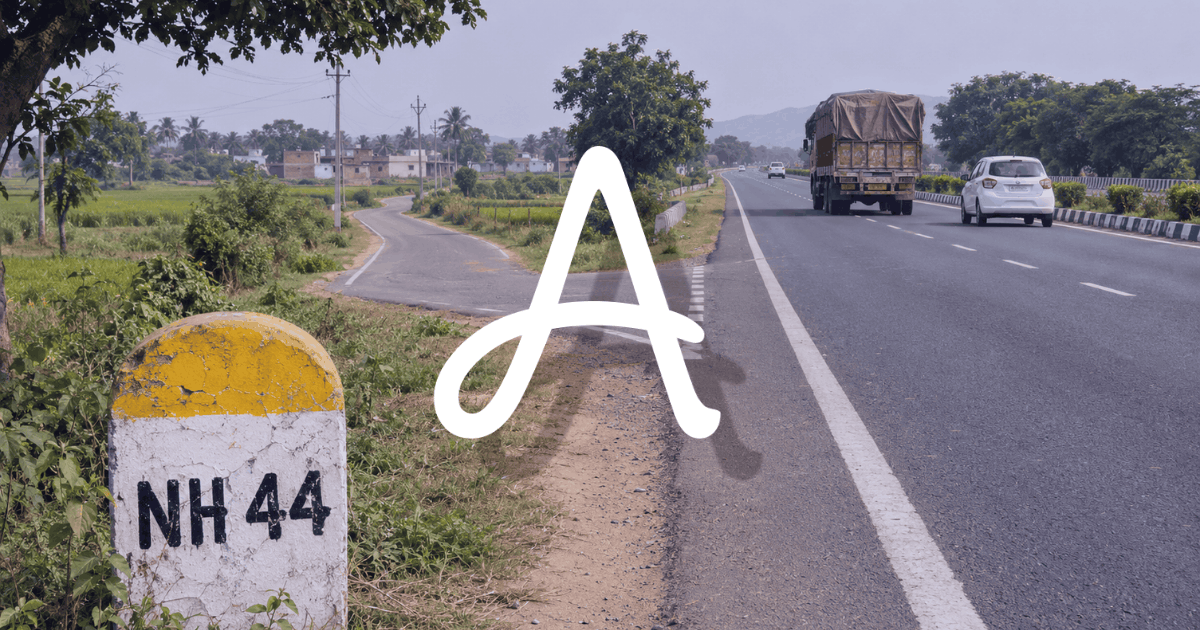
Example: NH44 connects Srinagar with Kanyakumari. It is a useful illustration of a highway serving journeys across many states.
Development and maintenance of NHs are the Central Government’s responsibility, but work is carried out through several agencies. These include the National Highways Authority of India (NHAI), National Highways and Infrastructure Development Corporation (NHIDCL), Border Roads Organisation (BRO) and state Public Works Departments (PWDs). NHAI is therefore not the agency responsible for every NH stretch.
SH: State Highway
State Highways provide the main connections within a state, linking district headquarters and important towns with the wider highway network. A journey from a district centre to another major town may rely heavily on an SH even when no NH is involved.
Example: Kerala’s Main Central Road, commonly called MC Road, is identified as SH1. Kerala PWD project records identify the Chengannur, Ettumanoor and Muvattupuzha stretch under that designation.
The practical distinction is the network each serves: NH for national connections, SH for important connections within a state. An SH can still be a busy, substantial road.
MDR, ODR and VR: from district routes to village access
MDR: Major District Road
An MDR is an important district connection. It helps move people and goods between production areas, markets and the main highway system. Think of a route that gathers traffic from several smaller roads and carries it towards a larger town or highway.
Recorded example: Kerala PWD’s road register dated 14 November 2019 lists the Mutholy-Kongandoor road under MDR. Check the latest state register for its present classification, as road categories can change.
ODR: Other District Road
An ODR serves rural areas and gives them access to markets, taluka or tehsil headquarters, block headquarters or more important roads. Its role is more local than that of an MDR.
Illustrative example: a road carrying traffic from a farming area to a nearby market town and an MDR junction. This describes the kind of connection an ODR provides; the state’s road inventory determines the actual classification.
VR: Village Road
A Village Road connects a village or group of villages with another village or the nearest higher-category road.
Illustrative example: a link from a village to a neighbouring village and onward to an ODR. VR describes its function, not whether its surface is earth, bitumen or concrete.
States are responsible for declaring roads as MDR, ODR and VR. A local road’s appearance alone is not enough to assign one of these labels.
AH: why a road can have an international label too
AH stands for Asian Highway, the network coordinated through the United Nations Economic and Social Commission for Asia and the Pacific (ESCAP). It identifies routes of international importance, while the roads also retain their domestic identities.
Examples: AH1’s published itinerary includes Moreh, Imphal, Kohima and Dimapur in north-east India. AH2 also has Indian sections. Indian government project descriptions identify the NH327B connection at the Mechi crossing towards Nepal as part of AH2.
In that example, NH327B identifies the Indian highway and AH2 identifies its place in the international network. An AH label is not a promise that every section is an expressway or has the same road standard.
Expressways and NE: controlled access is the key
An expressway is designed for through traffic, with entry and exit at designated points. Intersecting routes cross at different levels rather than meeting at ordinary crossroads on the main carriageway.
Example: the Ahmedabad-Vadodara Expressway in Gujarat is designated NE1, meaning National Expressway 1.
Expressways can belong to central or state road networks. Do not assume that every expressway must carry an NE number, or that every NH is an expressway. The route designation and the way the road is designed are separate details to check.
What the numbers and local names tell you
The revised numbering system gives India’s primary NH routes a broad geographical pattern:
- Predominantly north-south routes: even numbers, increasing from east to west.
- Predominantly east-west routes: odd numbers, increasing from north to south.
This describes the overall orientation of a primary route. It does not mean every bend follows that direction. Older maps and familiar local names may also use an earlier highway number, so check the current official designation when identifying a particular stretch.
Terms such as bypass, ring road and service road describe a road’s purpose or arrangement. They do not, by themselves, tell you whether it is an NH, SH or another category. India’s network also includes urban roads and project roads serving activities such as mining, forestry, irrigation and power generation.
For a journey, use the road code to understand the route, then check the actual section’s condition, access arrangements and current signs. Our road trip planning guide covers preparing your car and planning stops.
Frequently asked questions
Does an NH have to be a four-lane road?
No. NH identifies a road’s place in the national network, not a fixed number of lanes. Lane count and access control are separate characteristics of the particular stretch.
Can the same road be both an NH and an AH?
Yes. An Indian highway can form part of an Asian Highway route. The NH327B and AH2 connection near the Mechi crossing illustrates how a domestic highway number and an international route designation can refer to the same connection.
Does widening a village road automatically make it an MDR?
No. Widening changes the road’s physical form. Its category depends on the state’s official classification, so a wider surface alone does not establish MDR status.
Is an Asian Highway always a high-standard expressway?
No. The Asian Highway network includes roads in different design classes. AH identifies the international route; it does not establish the access control or lane count of every section.
