



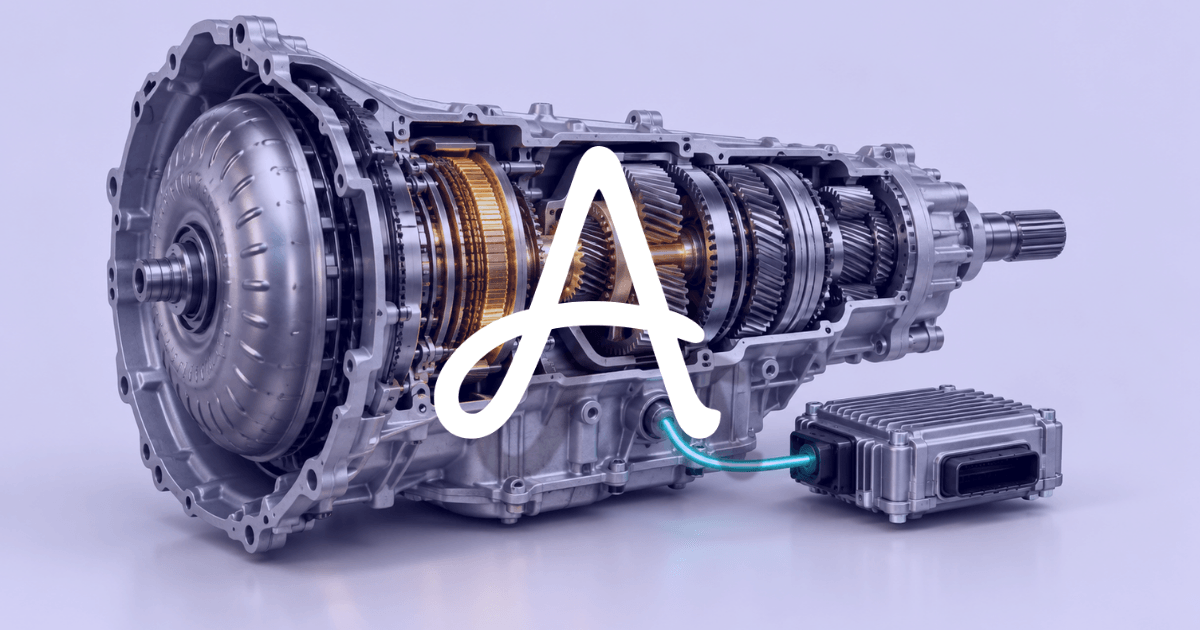
An automatic gearbox decides when to change gear by combining information about the car’s speed, engine speed and how much acceleration you want. In a modern automatic car, a transmission control unit uses these inputs and programmed shift rules to choose a suitable gear, then commands the mechanisms that make the change.
That is why the same car can shift early when you accelerate gently but hold a lower gear when you press the accelerator harder. There is no single road speed or engine RPM at which every automatic must shift.
How an auto gearbox decides when to shift
Think of the decision as three steps: measure what is happening, choose a ratio, and carry out the gear shift. This explanation focuses on modern electronically controlled transmissions; older hydraulic automatics do not all use the same electronic system.
1. Sensors report the driving conditions
The controller receives signals from transmission sensors and other vehicle systems. Depending on the design, the useful inputs include:
- Vehicle speed: How quickly the car is travelling.
- Engine speed: How fast the engine is turning, measured in revolutions per minute, or RPM.
- Accelerator input: How much acceleration the driver is requesting.
- Transmission shaft speeds: How fast rotating parts inside the gearbox are moving.
- Temperature: Whether operating conditions call for a different transmission strategy.
- Selected driving mode: Whether the driver has chosen normal Drive, Sport or a supported manual mode.
No single sensor makes the decision on its own. Engine RPM without road speed and driver demand would give the controller an incomplete picture.
2. The controller chooses the gear
The transmission control unit, also called a TCU or TCM, processes these inputs. In some vehicles, transmission control is part of a combined powertrain control module.
Its software contains shift schedules, often called shift maps. These define when a gear change is appropriate under different conditions. The aim is to balance the requested acceleration, fuel economy and shift comfort within the engine and transmission’s operating limits.
With gentle acceleration, the system can select a higher gear sooner. With a stronger acceleration request, it may hold the current gear longer or choose a lower one. Temperature, load and the selected mode can change that decision.
3. Actuators make the change
Choosing a gear and physically engaging it are separate jobs. The controller sends commands to actuators, which turn an electrical instruction into mechanical movement or controlled hydraulic pressure.
In a typical modern torque-converter automatic, electrically operated valves called solenoids regulate hydraulic circuits. These circuits control the internal friction elements that establish the selected gear ratio. The controller manages the change so it happens with the intended timing and feel.
The torque converter is not the part that independently decides when to shift. The control system makes that decision.
Why the gear shift changes with your driving
Imagine travelling at the same road speed in two situations: cruising gently on a level road and asking for stronger acceleration on a climb. A suitable gear in the first situation may not be suitable in the second.
| Driving situation | What the transmission may do |
|---|---|
| Gentle acceleration on level ground | Upshift sooner because the driver is asking for relatively little acceleration. |
| A firm press on the accelerator | Hold a lower gear or downshift to provide stronger acceleration. |
| Climbing a hill | Use a lower gear when the increased load calls for it. |
| Sport mode selected | Hold lower gears longer and shift at higher engine speeds, depending on the vehicle. |
| Different operating temperature | Adjust its shift strategy according to the manufacturer’s calibration. |
A downshift in response to a strong accelerator input is commonly called kickdown. The available lower gear depends on road speed, engine speed and the transmission’s limits. A hard pedal press does not guarantee the same downshift every time.
For the underlying reason different ratios are useful, see our explanation of why a vehicle needs a gearbox.
Do all automatic gearboxes shift the same way?
The broad idea of matching the transmission ratio to driving demand is shared, but the hardware differs.
- Torque-converter automatic: The controller operates hydraulic mechanisms to change between fixed gear ratios.
- Dual-clutch transmission, or DCT: Electronic control coordinates two clutches and the gear-selection mechanisms.
- Automated manual transmission, or AMT: Actuators operate the clutch and gear-selection mechanism, taking over jobs a driver performs in a manual car.
- Continuously variable transmission, or CVT: A conventional belt- or chain-and-pulley CVT varies its ratio through a range instead of relying only on fixed gear steps. Some versions simulate stepped shifts, so the sensation can resemble a conventional automatic.
This distinction matters when describing an automatic car. A CVT changing its ratio and a stepped automatic shifting from third to fourth are different mechanical events, even though both respond to driving demand.
FAQs about automatic gear changes
At what RPM should an automatic gearbox change gear?
There is no universal shift RPM. The appropriate point depends on the engine, transmission, accelerator input, vehicle speed and operating conditions. One fixed RPM figure cannot describe every car or every journey.
Does a drop in RPM always mean the car has shifted up?
No. In a torque-converter automatic, engagement of the converter’s lock-up clutch can also lower engine RPM without a change to the selected gear. The rev counter alone cannot identify every transmission event.
Can paddle shifters override the automatic gearbox?
Paddles let the driver request a gear change on vehicles equipped with them. How long manual control lasts, and whether the system automatically shifts at engine-speed limits, varies by model. Check the owner’s manual for the behaviour of your car.
