



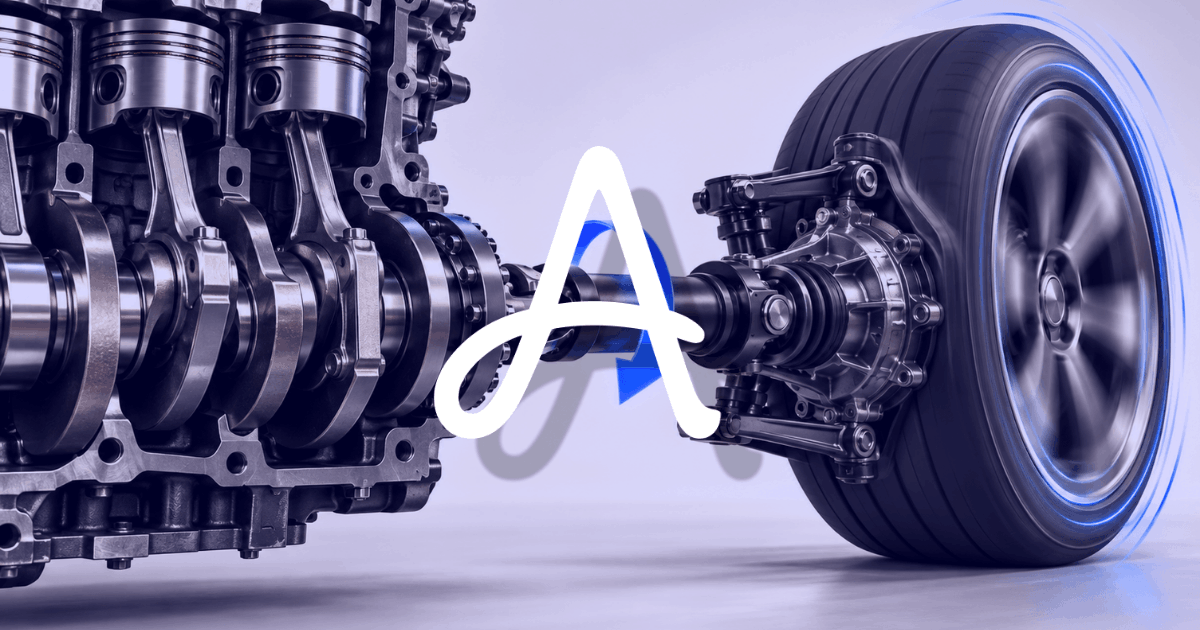
Torque is the twisting force an engine or motor produces. Horsepower measures how quickly that turning force can do work. In a car, both affect acceleration, but neither peak number tells the whole story. The engine speed at which the force is available, the gearbox and the car’s weight also matter.
What is torque in a car?
Imagine pushing a door near its hinges, then pushing the same door near its handle. The push is easier to turn into movement at the handle because it acts farther from the pivot. Torque describes that turning effect. In a car, engine torque is the turning force at the crankshaft. An electric motor produces torque at its shaft.
Specifications usually show torque in newton-metres (Nm) or pound-feet (lb-ft), followed by the engine speed where the quoted value occurs. For example, a hypothetical specification of 200 Nm at 2,000 rpm says the engine reaches that torque at 2,000 revolutions per minute. It does not mean the same torque is available at every speed.
Torque vs horsepower: what is the difference?
Torque describes turning force. Horsepower describes power, or how quickly work is done. Engine speed connects the two: an engine producing torque while spinning faster can produce more power. The familiar relationship is horsepower = torque (lb-ft) × rpm ÷ 5,252. With metric units, power (kW) ≈ torque (Nm) × rpm ÷ 9,550.
| Measure | What it tells you | Common units |
|---|---|---|
| Torque | Turning force at a stated engine or motor speed | Nm or lb-ft |
| Power | How quickly that turning force can do work | hp, bhp or kW |
A car with strong low-rpm torque can feel responsive without frequent downshifts. A car that keeps making useful torque at higher rpm can build more power as it revs. That is why the shape of the torque curve matters more than treating either peak figure as a complete verdict.
Why torque matters when you drive
When you accelerate, the force that pushes the car forward comes from torque at the driven wheels. The gearbox changes that wheel torque: a lower gear multiplies torque more than a higher gear, while the wheels turn more slowly for a given engine speed. The tyre grip and vehicle weight affect how much of that force becomes acceleration.
- Pulling away or climbing: A suitable low gear helps provide the wheel torque needed to move the car against load.
- Everyday acceleration: Useful torque across the rpm range you normally use can make the car feel flexible.
- Higher-speed acceleration: Available power becomes increasingly important as the car must deliver force while moving faster.
If you want to see how the transmission chooses a ratio in practice, read our guide to how an automatic gearbox decides when to shift. Our article on why a car needs a gearbox explains the gearbox’s basic role.
How to compare horsepower vs torque figures
Read the rpm beside each peak figure, then look for a torque or power curve if the manufacturer provides one. A high peak torque figure at an engine speed you rarely use may tell you less about everyday response than a broad spread of usable torque. Likewise, peak horsepower alone does not tell you how strongly the car pulls in one gear at a particular road speed.
Compare like with like. Engine figures and wheel figures are measured at different points in the drivetrain. Vehicle mass, gearing, traction and transmission behaviour can make two cars with similar quoted outputs feel different. A test drive or trustworthy instrumented test can help where specifications cannot.
Frequently asked questions
Is bhp the same as torque?
No. BHP means brake horsepower, a measure of engine power. Torque measures turning force. Brake horsepower is determined from torque and engine speed during an engine test, so a bhp figure is not a second type of torque.
Does more torque always mean faster acceleration?
No. Engine torque alone leaves out gearing, engine speed, vehicle mass and grip. The torque actually available at the wheels in the gear being used is what helps produce acceleration. Compare the complete vehicle and its usable power range, not just the largest torque number.
Why can peak horsepower occur at a higher rpm than peak torque?
Power depends on both torque and rotational speed. Even after torque has passed its peak, rising rpm can continue to increase power until the drop in torque outweighs the extra speed.
