



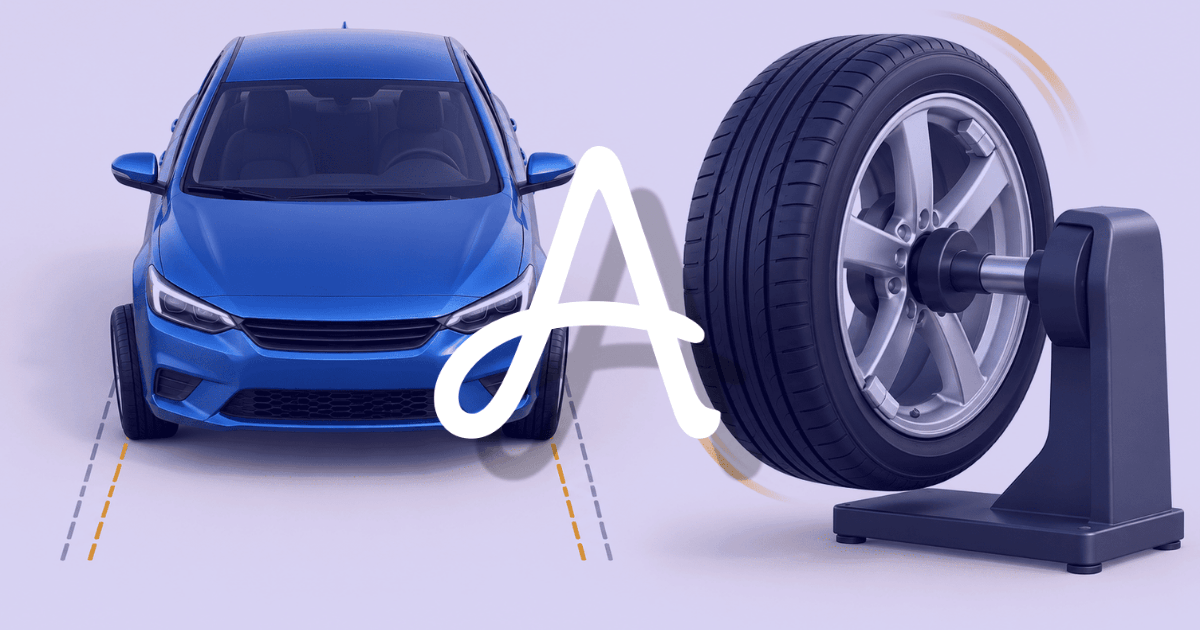
While driving on highway, have you ever noticed a truck or a car that is going in speed, but is running straight, has some angle between front and read? Wheel alignment corrects wheel angles through adjustments to the suspension, while wheel balancing corrects uneven weight distribution in each tyre and wheel assembly. If your car pulls to one side or wears a tyre unevenly, ask for an alignment inspection. If it vibrates at certain road speeds, ask for a tyre, wheel and balance check.
These are starting points, not a diagnosis. Incorrect tyre pressure, damaged tyres and worn components can produce similar symptoms. The right wheel servicing starts with finding the cause rather than automatically buying both services.
Wheel alignment vs wheel balancing: match the symptom to the check
| What you notice | What to ask the workshop to check | What else matters |
|---|---|---|
| The car consistently pulls to one side | Tyre pressures and condition, followed by alignment measurements | A pull alone does not prove the alignment is wrong. |
| The steering wheel sits crooked while travelling straight | Alignment and steering-wheel centring | Mention any recent impact or steering work. |
| One tyre edge wears faster than the rest | Alignment, tyre pressure and suspension condition | Adjustment cannot replace rubber already worn away. |
| The steering wheel, seat or floor vibrates at a particular speed | Tyre and wheel condition, mounting and balance | A damaged tyre or wheel can also cause vibration. |
| Shaking or pulling appears mainly when braking | Brake inspection as part of a wider diagnosis | Do not assume balancing alone will solve it. |
| Handling changes after a pothole or kerb impact | Tyres, wheels, steering and suspension before deciding on alignment or balancing | An impact may cause damage as well as disturb settings. |
Tell the technician when the symptom started, where you feel it and whether braking changes it. Do not accelerate to reproduce a vibration or let go of the steering wheel to test a pull.
What wheel alignment changes
An alignment machine measures the wheel angles against the vehicle manufacturer’s specifications. The technician adjusts the relevant suspension settings where the vehicle allows it.
The main measurements are camber, caster and toe. They describe wheel tilt, steering-axis angle and the direction the wheels point. For the detailed geometry, read our guide to camber, caster and toe in vehicle alignment.
Correct alignment helps the tyres wear evenly and supports predictable vehicle control. It is worth checking when the steering wheel is off-centre, the car develops a persistent pull, or unusual tread wear appears. A significant impact or work affecting steering and suspension geometry is also a reason to ask the workshop whether a check is needed.
Ask for the before-and-after measurements and an explanation of any readings that remain outside specification. Worn or damaged parts need attention before a final adjustment can be relied on. An alignment is not a repair for a bent wheel or a damaged tyre.
What wheel balancing changes
A tyre and rim can have uneven weight distribution even when they look normal. During wheel balancing, a technician spins the assembly on a balancing machine, measures the imbalance and fits corrective weights at the required positions. Imbalance often becomes noticeable as vibration within a particular speed range. You may feel it through the steering wheel, seat or floor. Where you feel it helps describe the problem, but does not identify the faulty wheel with certainty.
Balancing belongs with tyre fitting: newly fitted or refitted tyres should be balanced. A missing balance weight or vibration after tyre work also warrants a check. Balancing does not adjust suspension geometry, so it will not correct an alignment-related pull.
What to check before booking wheel servicing
1. Check pressure and visible tyre condition
With the tyres cold, check pressures against the vehicle’s tyre placard or owner’s manual, including any guidance for the load you carry. Do not use a single assumed pressure for every car. Our guide to the effects of low tyre pressure explains why inflation matters for handling.
Look for uneven tread wear and visible damage from a safe position while parked. If a tyre repeatedly loses pressure, have the leak investigated rather than relying on repeated top-ups.
2. Describe the problem before choosing the service
A useful description is: “The steering wheel started vibrating after the new tyres were fitted; it happens during normal cruising and is not limited to braking.” That gives the workshop more to investigate than simply requesting an alignment. Likewise, a car that pulls and also vibrates may need more than one correction. Ask what the inspection and measurements show before approving a package of work.
3. Treat severe changes as a reason to stop
If strong vibration, sudden pulling or a major change in vehicle stability develops, reduce speed carefully and stop somewhere safe. Arrange assistance if the car cannot be controlled normally or damage is suspected. A tyre with a sidewall bulge needs professional attention and should not be driven on; alignment or balancing cannot make it safe.
Do you need both services at the same visit?
Sometimes. New tyres need balancing, and checking alignment at the same visit can identify settings that might cause premature wear. However, an alignment check and an alignment adjustment are different jobs. Ask whether the measured angles actually require correction.
Follow the vehicle manufacturer’s maintenance guidance rather than treating one mileage interval as a rule for every car. New symptoms and impacts deserve attention even if the next scheduled service is some distance away.
After the work, ask the workshop to confirm whether the original complaint has been resolved. If vibration remains, further diagnosis is needed rather than assuming another alignment will fix it.
Frequently asked questions
Can wheel alignment fix steering-wheel vibration?
It may help if incorrect geometry and associated tyre wear contribute to the problem, but it is not a universal vibration fix. Speed-related shaking calls for checks of the tyres, wheels and balance, with further inspection if those do not explain it.
Do new tyres need balancing and alignment?
Newly fitted tyres should be balanced. An alignment check is sensible at fitting, especially if the old tyres wore unevenly or the car has a handling complaint. Adjustment depends on the measurements and the manufacturer’s specifications.
Is tyre rotation the same as balancing?
No. Rotation moves tyres between wheel positions according to an appropriate pattern for the vehicle. Balancing corrects uneven weight distribution. Rotation does not replace balancing or alignment.
Why does the car still vibrate after balancing?
Imbalance may not have been the only cause. Tyre damage, wheel damage or other mechanical problems may need investigation. Return with a clear description of the remaining symptom and ask for a diagnosis rather than another service chosen by guesswork.
